Creativity & Innovation in the Elementary Classroom
What is the role of creativity and innovation in creating environments that enhance language learning and student engagement?
Why Creativity is Important
Elementary classrooms, especially in the primary grades (Grade 1 - Grade 3), are places where students should be encouraged to explore, create and take risks in their learning. It is through these creative experiences, that students will be able to develop literacy skills while also strengthening their communication, critical thinking, problem solving and collaboration. Research suggests that creativity helps build confidence and perseverance (Beghetto, 2010).
Piaget (1962) expressed that students learn through participation and interactions within their own environment. This discovery allows children to be creative and to construct their own knowledge and understanding of the world in which they live. The goal with using creativity strategies and tools is so students can learn to communicate their frustrations, learn to listen to other perspectives, and work together to solve problems.
Physical Space
The strategic physical layout of a classroom is instrumental in promoting student creativity and innovation. “Studies suggest that traditional teacher-directed classes may not create an atmosphere conducive to student thoughtfulness” (Case & Balcaen, 2006, p.86). The careful placement of furniture and the learning spaces that are created are instrumental in being able to promote a creative and innovative space for students to work and learn. In a traditional classroom the teacher was up front and lecturing with students placed in strict rows. This structure is not relevant for today’s learners as “today’s economy requires employees to have more complex skills that are more challenging to learn in a traditional classroom setting” (Klee, 2025, para. 1).
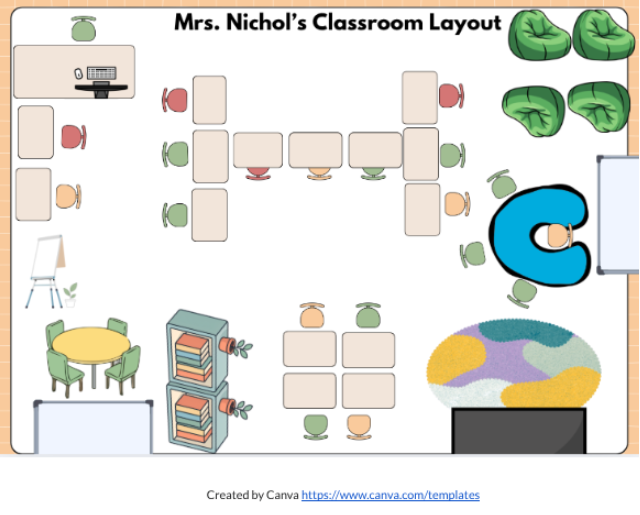
Having a flexible room layout offers English language learners opportunities for low-stakes language practice. By arranging desks in groups rather than in single rows allows for peer modeling and collaboration.
Classroom Environment
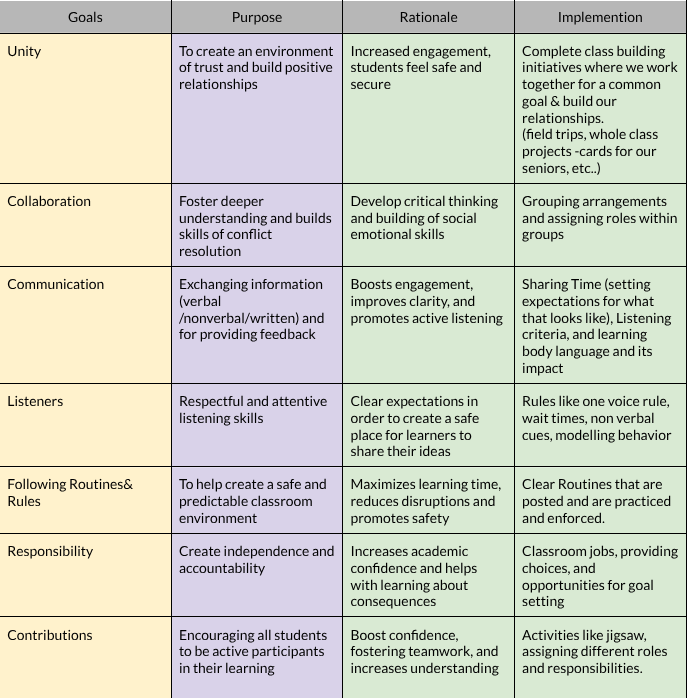
Case and Balcaen (2006) emphasize the importance of building a caring learning community. This is especially the case for welcoming English language learners, as you want to create a strong learning community. The table below contains some of the goals mentioned by Case and Balcean (2006), which are excellent strategies to employ in order to create a powerful and creative environment for students.
Social Interactions
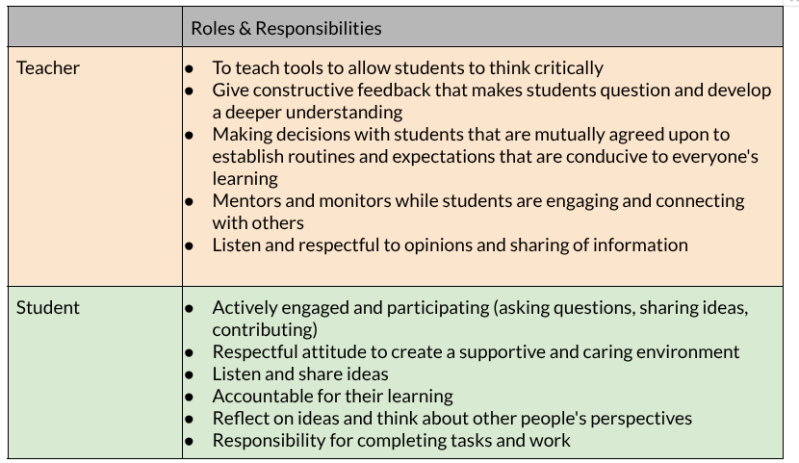
The goal is to create a space that caters to students working together, sharing ideas and being able to take risks in order to explore and learn. Building a successful classroom community is essential especially for making our English language learners feel comfortable. Once ELL learners develop connections and relationships, their ability to participate and engage in learning increases. Both educators and students play a role in developing these social relationships. "Students’ sense of being able to influence their learning, as opposed to relying exclusively on someone else- typically a teacher- to direct them, is a significant factor in encouraging students to think for themselves (Case & Balcean, 2006, p.92). Featured below is a table that contains teacher and students roles in the classroom to allow for a learning community environment to happen.
Assessment
Shively et al. (2018), discuss the importance of developing critical and creative thinkers in order for students to become global problem solvers. Many traditional assessments and rubrics are focused on summative or finished products. These are not accurate assessments for being able to observe and assess creative or critical thinking. What Shively et al. (2018) recommend is using the Design Thinking Model (DTM) when it comes to assessment. “Teachers may tailor these rubrics to assist in measuring the essential, yet complex, cognitive process and clearly convey to students the characteristics and practices of a good thinker and designer (Shively et al., 2018, p.148).
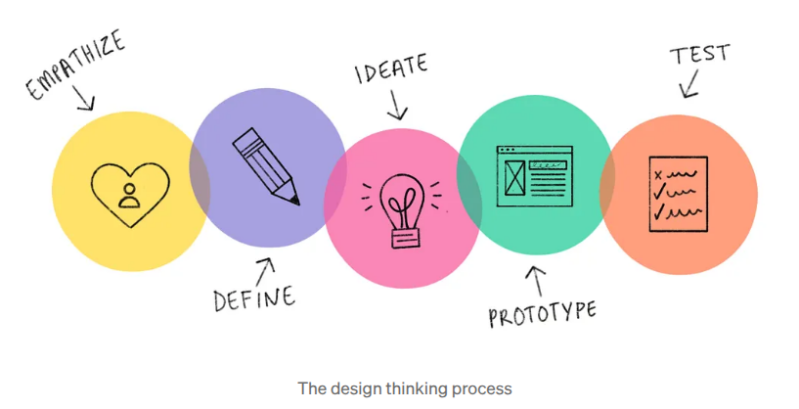
Retrieved from https://medium.com/swlh/how-to-use-design-thinking-in-the-ux-design-process-e33c4f11a6be
The Design Thinking Model allows ELL learners to demonstrate critical thinking, problem solving and comprehension through visual and hands-on materials, rather than solely relying on written English.

Research Spotlight
November stated, “students need a chance to leave a legacy” (November, 2011). Providing students with inviting environments and being aware of their learning needs allows educators to best support students in the classroom. Creating activities that are student-centered allows room for differentiation as the teacher can help guide and support students who may need a bit more support but also allow room and time for them to help students expand their thinking and to provide challenges.
Recommendation for Teachers
1. Create warm and welcoming spaces for students, to foster a positive learning environment.
2. Change the physical space of the classroom to accommodate different learners.
3. Encourage social interactions between peers and other classes to learn important communication skills.
4. Allow for accommodations and alternative modes of assessments.
Personal Experience
I have played with the physical layout of my classroom for the last few years. Trying to build multiple different spaces in order to acknowledge how each learner learns the best. In creating these spaces I am able to accommodate different styles of learning and create a positive learning environment. As current research states the traditional method of instruction and teaching is not for all learners. This is why I have grown as an educator and want to provide my students with opportunities to learn in a way that is conducive for them.
My most recent addition was creating a small nook in the corner of my classroom. In the nook there is a book shelf that holds a variety of different reading genres, chromes, headphones, c-pen, and other reading materials. There is a small table with 2 chairs and 2 beanbags. My students love going to this area to read either independently or with a partner. This space is so popular that even in other subject areas when a student needs a quiet place they ask to go to this area.
My biggest takeaway is to listen to students and see what their needs are. Teaching students to advocate for their own learning needs is powerful and will allow them to thrive. I pride myself in creating lessons, units and activities where Universal Design for Learning is applied. This allows my students to be engaged in the learning process and learn critical thinking and problem solving skills that they need in order to be successful.
Continued Research.....
An area that I would like to continue to grow is to further find ways to engage students in literacy and develop strategies to help English learners. I have recently purchased Innovation, Literacy, and Arts Integration in Multicultural Classrooms: Theory and Practice for Designers of K-8 Learning Environments by Christine Wood, Laurie Stowell and Merryl Goldberg. The book will offer research-based theories and practices to connect literacy and the arts. The hope is to use this content to grow in use of different frameworks and models to create innovative, accessible and equitable learning contexts for students. I will then be able to update and share my findings on my website.
Next Steps
1. Redesign your classroom space. Are you able to create little books and offer a variety of different seating and working environments? (garage sales and colleagues are great sources for furniture and supplies)
2. In the next Community of Practice meeting with colleagues, challenge yourself by planning assessments and activities that foster Universal Design of Learning.

References
Beghetto, R. A. (2010). Creativity in the classroom. In J. C. Kaufman & R. J. Sternberg (Eds.), The Cambridge handbook of creativity (pp. 447–463). Cambridge University Press.
Case, R., & Balcaen, P. (2006). Supporting a community of critical thinkers. In R. Case & P. Clark (Eds.), The anthology of social studies (Vol. 1, pp. 89–98). Pacific Educational Press.
Klee, P. (2025, March 20). Next generation learning spaces to improve learning in schools. Next Generation Learning Challenges. https://www.nextgenlearning.org/articles/next-generation-learning-spaces-to-improve-learning-in-schools
Piaget, J. (1962). Play, dreams and imitation in childhood (C. Gattegno & F. M. Hodgson, Trans.). W. W. Norton & Company.
Shively, K., Stith, K., & Rubenstein, L. D. (2018). Measuring what matters: Assessing creativity, critical thinking, and the design process. Gifted Child Today, 41(3), 149–158. https://doi.org/10.1177/1076217518768361
TEDx Talks. (2011, March 25). TEDxNYED - Alan November - 03/05/2011 [Video]. YouTube. https://www.youtube.com/watch?v=ebJHzpEy4bE